
Pianist
Composer
Writer
Reviews
& References
Discography
Videos
Books (inventor-musicæ™)
PhotosSubscribe
Unsubscribe
(mailing lists)
Türkçe
Site-map andalphabetical index
     |
 |
||
|
David Ezra (prev. Mehmet)
Okonşar, composer
|
|||
|
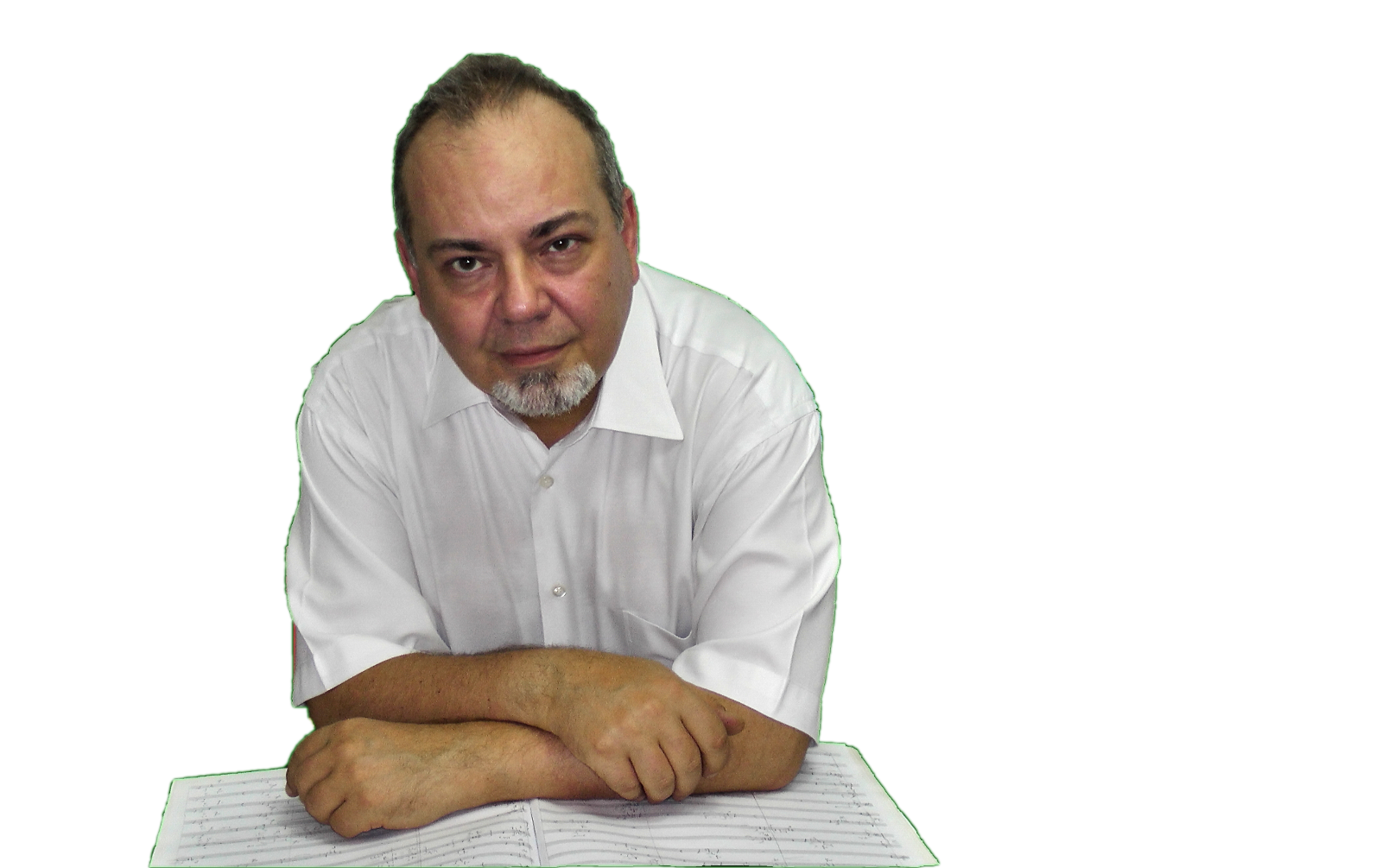
David Ezra Okonsar began composing music at the age of 11, drawing inspiration from the revolutionary works of Arnold Schoenberg and Pierre Boulez. From an early age, Okonsar was captivated by the possibilities of atonality and serialism, which would become central to his compositional language. A transformative moment came when he discovered a copy of Boulez's Third Piano Sonata in the library of the Ankara State Conservatory. This encounter set him on a path of deep exploration into avant-garde music. The French Cultural Centre of Ankara, with its extensive mediatheque, offered Okonsar access to an extraordinary range of recordings and scores. The works of Edgar Varèse, Pierre Schaeffer, Iannis Xenakis, and Olivier Messiaen profoundly influenced the young composer, shaping his artistic vision and sensibilities. After completing his piano studies, Okonsar pursued advanced training at the Brussels Royal Conservatory of Music under the guidance of Madame Jacqueline Fontyn, one of Belgium’s foremost composers. Fontyn’s expertise in modern composition and orchestration significantly informed Okonsar’s approach. Additionally, he benefited from the mentorship of Claude Ballif, the renowned analysis teacher at the Paris Conservatory, who deepened Okonsar’s understanding of contemporary musical structures and forms. From the outset, Okonsar’s compositions were marked by their fearless exploration of unconventional forms and ensembles. His works pushed the boundaries of serialism, incorporating elements of atonal jazz and the improvisatory techniques of musicians like Cecil Taylor and Bill Evans. These influences added a unique rhythmic and harmonic complexity to his music, blending seamlessly with the extended serial techniques that remained a constant in his work. During the 1980s, Okonsar expanded his horizons further, drawing on the innovations of Krzysztof Penderecki, Iannis Xenakis, and György Ligeti. Their pioneering approaches to texture, timbre, and spatial composition resonated deeply with Okonsar, encouraging him to develop a highly individual style characterized by intricate layering and structural depth. The practice of electronic music by figures such as Ligeti, Stockhausen, Xenakis, and Pousseur in the 1960s introduced a radically modern perspective on orchestration. Concepts like "sound envelopes," "filters," and "formants" began to redefine the potential of acoustic and electronic instruments alike. In the 1990s, Okonsar adopted similar principles, integrating these techniques into his orchestral and chamber works. His symphony Baroque Horizons exemplifies this synthesis, blending electronic textures with baroque-inspired counterpoint in a strikingly modern framework. Okonsar’s recent compositions further demonstrate his innovative approach. Works such as Sounds and Perfumes Turn in the Evening Air, for piano and electronically processed piano, and Jacob’s Ladder: Five Ascensions for Piano, inspired by biblical themes, showcase his ability to fuse traditional and avant-garde elements. His suite Imugi’s Dream, a twelve-piece cycle for piano and cello, draws from Korean mythology to create a rich narrative tapestry. Meanwhile, his 20 Preludes for Solo Piano reveal a masterful command of atonal language, blending rigorous structural techniques with emotive and virtuosic expression. Okonsar’s music is known for its meticulous construction, presenting a highly structured inner core that invites and rewards analytical engagement. His scores are distinguished by their precision, intricacy, and refined detail, reflecting his deep commitment to the craft of composition. In recognition of his significant contributions to contemporary music, David Ezra (formerly Mehmet) Okonsar received the Gold Medal from the "Académie Internationale des Arts Contemporains" of Enghien, Belgium. Today, he continues to push the boundaries of musical innovation, leaving an indelible mark on the world of contemporary classical music.
|
|||
| Review all my compositions in a short
video... |
|||
|
Music Scores
|
|||
 |
Piano Concerto in C (2020) The Piano Concerto in C is actually a serial, twelve-tone piece. However the series were elaborated to emphasize a "gravity" center around C and creating "flavors" of major, minor and modal settings. Remaining movements use variants of this tone-row. Those variants emphasize diminished/augmented fourths and fifths and minor/major third intervals. For solo piano and medium orchestra Details... |
||
 |
Symphonic poem in four movements for large
orchestra: oRRaz ("Light and Mystery") The symphony is inspired by the work of Yehudah Halevi (1075/86 - 1141) Spanish Jewish physician, poet and philosopher. Specifically the Ayin Nedivah (“Generous Eye”) a Qasida For Solomon Ibn Ghiyyat; as well as the Gematria relationship between the Hebrew letters making for “or” (light) and “raz” (secret – mystery). For large orchestra Details... |
||
 |
Sonata in Two Movements for Expanded Piano: Remez (hints) Remez can be translated as alluded meaning (reading between the lines), in modern Hebrew it means hint. And traditionally, “remez” refers to methods such as “gezera shava” (equivalent language implying equivalent meaning) and “gematria” (word-number values). The two movements of this Sonata: “Gezera shava” and “Gematria” adopt the two methods of “remez” for revealing the hints (deep, allegorical, symbolic meanings of texts) and applies them to musical materials, specifically series, rows of musical entities, often rooted in but not exclusively limited to 12-tone techniques. For solo piano and synthesizer (or "tape") Details... |
||
 |
Sixteen Short Sonatas For The Solo Piano
(2020) The Sixteen Short Sonatas for the piano is a series of relatively terse pieces for the solo piano. The écriture is often more straightforward than in my lengthier projects. The title Sonata is employed here in the Baroque sense of the word. One indivisible musical texture which is not dualistic as with the classical sonata neither programmatic as with the romantic sense of the form. For the solo piano Details... |
||
 |
Malakhim (Messengers, Angels) Ten Pieces Malakhim (מלאכים, melakhim, malachim), often translated as "angels", literally means messengers. This aspect of the concept constitutes the basic idea for the composition. Titles and order of the pieces are based on the commonly accepted names and hierarchical order of angels, as established by Moshe bin Maimon (Maimonides a.k.a Rambam, 1135-1204). The ten pieces for the piano, inspired by the denominations, hierarchical order (reversed) and commonly given attributes of beings referred to as "angels" (Malakhim, messengers) as described by Maimonides are: I - Ishim: "manlike" beings [Genesis 10-5 and Daniel 10-5] II - Cherubim: "unearthly beings who directly attend to God" [Ezekiel 10-1] III - Bene Elohim: "Sons of Godly beings" [Genesis 6:1-4 and Job: 1:6, Job: 38:7] IV - Elohim: "Godly beings" [Bereshit 1:1] V - Malakim: messengers, angels VI - Seraphim: "the burning one" [Isaiah 6] VII - Hashmallim: "stormy wind coming from the north" [Ezekiel 1:4] VIII - Erelim: "the valiant, courageous" [Isaiah 33:7] IX - Ophanim: "the wheels that never sleep" [Ezekiel 1 and Ezekiel 10] X - Chayot Ha Kodesh: "living beings, angels of fire" [Ezekiel 1 and Ezekiel 10] ... For the solo piano Details... |
||
 |
Haikus Haikus, duo for cello solo and percussion attempts to bring into the musical world the particular aesthetics of the Haiku. The short poems known as Haiku are in essence very different from the poetic literature of the western world. By bringing together some phenomenon, facts generally gathered from nature, flowers, plants, animals, weather conditions and so, often by creating uncommon associations between them, these lovely short poems act as triggers to create feelings as an "after-effect". Haikus do not tell a story neither they describe personal feelings, rather they trigger feelings. Like a musical instrument which may create "resonances" which are related but somehow apart from the actual notes played. The piece is not based on any particular Haiku nor a series of them. As there are no real stories in Haiku, there is not any "theme" and "developments" in the piece. ... Duo for solo Cello and Percussion Details... |
|
|
 |
Eikhah (Lamentations) אֵיכָה How doth the city sit solitary, that was full of people! How is she become as a widow! She that was great among the nations, and princess among the provinces, how is she become tributary! ... Symphonic Poem in Five Movements for Grand Orchestra |
||
 |
Haazinu (Listen!) הַאֲזִינוּ Listen, O heavens, and I will speak! And let the earth hear the words of my mouth! The Song of Moses Seven Pieces For The Solo Piano |
||
 |
Rhapsodies
Hébraïques Free form compositions based on popular Jewish melodies for the piano solo |
||
 |
Tehillim-Psalms Tehillim-Psalms: Six Psalms for Vocal and small orchestra (music score) |
||
 |
The
Temples of Kyoto Three pieces for the piano (music score) |
||
 |
Percussion-X
Music for 3 percussionists (music
score)
Instrumentation is left at
the discretion of the performers. However, the following rules apply:
Each performer (A, B and C) have a set of the same instrument with
undefined pitches classified as H (high) M (mid) L (low). Each
performer also has another instrument, different from the above
mentionned HML set, referred to as X.
|
||
 |
Kaleidoscopes Kaleidoscopes: Three pieces for
various instruments (music score)
Kaleidoscopes, is a series
of pieces created on one unique tone-row using its various
modifications. The tone-row is from Alban Berg's violin concerto ("To
The Memory of an Angel"). Number 1 for solo piano, 2 for chamber
orchestra, marimba and piano and 3 for viola and piano.
|
||
 |
Concertango Concertango: Concertino for piano and
small orchestra (music score)
Concertango is a classical
piano concerto, or "concertino", entirely based on themes and melodies
by Astor Piazzolla. I arranged these into a regular piano-concerto
orchestration.
|
||
 |
Chameleon & Emulation "Chameleon" & "Emulation": Pieces
for the piano
These represent my output
from 1986 to 2010. They range from my student days at the Brussels
Conservatory, under the guidance of Madame Jacqueline Fontyn to a time
I consider my style set. Chameleon: three pieces for
the piano. Emulation: five short pieces
for the piano.
|
||