Downloads only. Physical CD not available.
|
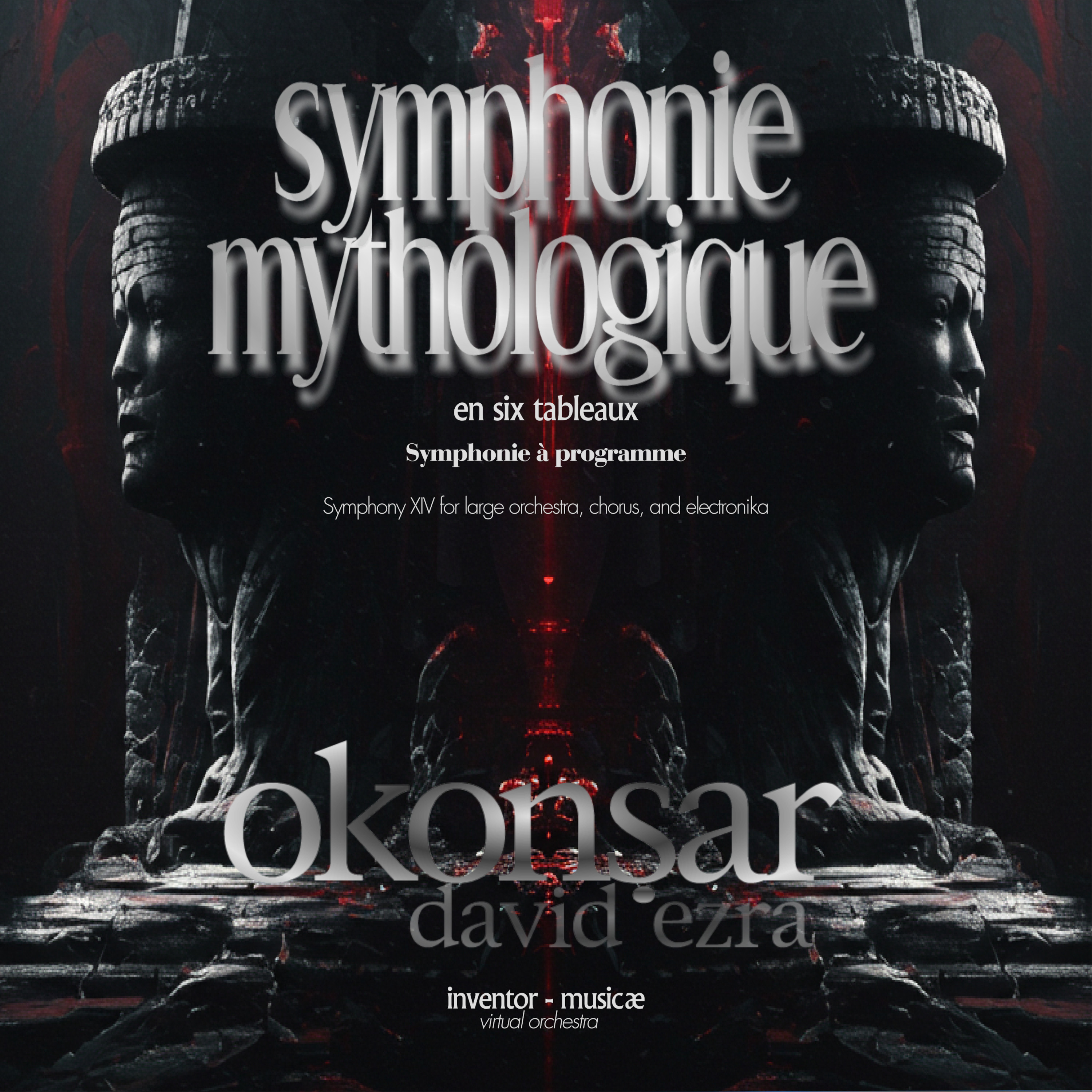
The Symphonie Mythologique is a monumental symphonic cycle in six vast movements—each conceived not as a traditional abstract movement but as a tableau vivant, a living canvas of sound, imagery, and myth. Spanning close to ten minutes each, these tableaux together form a symphony of approximately an hour in duration, a scale chosen deliberately to reflect the grandeur of the myths they invoke and to immerse the listener in a profound dramatic arc without the use of sung words. The composer has termed the work a “Symphonie à programme”—a deliberate echo of Berlioz’s Symphonie fantastique, yet conceived in a wholly contemporary idiom. Whereas Berlioz used his symphony to paint the narrative of a tormented artist in sound, here the orchestra, chorus, and electronica embody timeless mythological archetypes, weaving them into a seamless musical fresco. The symphony unfolds as a wordless opera, a theatre of voices, timbres, and leitmotifs that summon the listener into the realm of myth and memory. Each tableau draws from a myth of deep symbolic resonance—stories of gods, heroes, and mortals that have shaped humanity’s collective imagination for millennia. They are not mere retellings, but re-imaginings through sound, infused with both awe and intimacy. The myths chosen are not isolated tales; each reflects a universal theme: the quest for transcendence, the tragic price of ambition, the descent into the unknown, the fleeting nature of beauty, the struggle against fate, and the redemptive spark of light in darkness. Musically, each tableau is unified by the use of leitmotifs, thematic kernels that serve both as symbolic signifiers and as structural anchors. These leitmotifs recur, transform, and recombine across the tableaux, linking characters and ideas across the vast mythological panorama. Alongside the orchestra and chorus, a selection of solo instruments—two or three featured in each tableau—function almost as dramatis personae, embodying mythic figures through their timbral identity. Thus, a bass clarinet may evoke a descent into shadow, a harp may trace the fragile threads of fate, a trumpet may blaze with the fire of divine wrath. The orchestral palette is expanded with electronica, not as a decorative layer but as an integral dimension of the sound-world. Pulsating textures, spectral harmonies, and otherworldly resonances interlace with the symphonic fabric, creating a dialogue between ancient myth and modern sonority. The result is a music that is at once timeless and immediate, grounded in the monumental tradition of symphonic writing while speaking in the unmistakable language of the present. The work requires a large orchestra and chorus, not for sheer spectacle but to allow for vast contrasts: passages of overwhelming collective force that evoke the grandeur of Olympus, set against moments of the most delicate intimacy where a single line glows against silence. The chorus functions not as a text-bearing body but as a wordless collective voice—humanity itself, sighing, lamenting, or exalting beyond words. The six tableaux, each a self-contained universe, may be experienced individually yet are bound together as a single narrative arc. They unfold with the dramaturgy of opera: an opening prologue that sets the mythical stage, episodes of conflict, tragedy, and wonder, and a culminating resolution that does not merely end the story but refracts its themes into the listener’s imagination. Each tableau is conceived visually as well as musically, with imagery and scenography implicit in the sound itself: one may hear the ascent of Icarus in the soaring strings, the lament of Orpheus in the solo cello, the shimmering light of Ariadne’s thread in harp and celesta, the fiery revolt of Prometheus in brass and percussion. To listen to the Symphonie Mythologique is to enter a ritual space of sound, where the orchestra is transformed into a vast chorus of voices, instruments, and elemental forces. It is a work of monumental proportions yet also of intimate detail, where every note contributes to the unfolding drama. It is at once a symphony, an opera without words, and a meditation on the timeless power of myth to speak to the present. In conceiving this work, the composer sought not only to honor the monumental symphonic tradition but also to reimagine it for a new era, where electronic soundscapes coexist with acoustic instruments, where myth is both ancient memory and living presence, and where the symphony is not confined to abstraction but becomes a theatre of the imagination. Just as Berlioz’s Symphonie fantastique redefined the 19th-century symphony by giving it a programmatic voice, so too does this work aspire to redefine the symphonic form of today: as a Symphonie à programme, a vast, immersive, and deeply human journey into myth. The Symphonie Mythologique thus stands as a testament to the enduring power of orchestral music to tell stories, to embody archetypes, and to move between the monumental and the intimate. It is a work that invites the listener not merely to hear but to see in sound: to witness myth reborn in music, and to be carried, tableau by tableau, through an odyssey as old as humanity itself and as new as the sounds of tomorrow.
-------------------------------------------------- FR La Symphonie Mythologique est un cycle symphonique de proportions monumentales, composé de six vastes mouvements — chacun conçu non pas comme un mouvement abstrait traditionnel, mais comme un tableau vivant, une fresque sonore et imagée qui s’anime devant l’auditeur. Durant près de dix minutes, chaque tableau développe une scène dramatique autonome, si bien que l’ensemble de la symphonie atteint une durée d’environ une heure. Cette ampleur n’est pas fortuite : elle reflète la grandeur des mythes invoqués et permet d’immerger l’auditeur dans un arc dramatique d’une profondeur rare, sans recours aux mots chantés. Le compositeur a qualifié l’œuvre de « Symphonie à programme » — une appellation qui rappelle délibérément la Symphonie fantastique de Berlioz, tout en affirmant une écriture résolument contemporaine. Là où Berlioz dépeignait le destin halluciné d’un artiste romantique, la Symphonie Mythologique donne voix aux archétypes intemporels de la mythologie à travers un dialogue entre orchestre, chœur et électronique. L’ensemble se présente comme une opéra sans paroles : un théâtre sonore où les timbres, les leitmotivs et les masses orchestrales deviennent les acteurs d’un drame universel. Chaque tableau s’inspire d’un mythe de portée universelle, choisi pour sa résonance symbolique profonde. Ce ne sont pas de simples récits illustrés, mais des réinventions musicales où s’entrelacent grandeur et intimité. Le choix des mythes reflète des thèmes universels : la quête de la transcendance, le prix tragique de l’ambition, la descente vers l’inconnu, l’éclat fugitif de la beauté, la lutte contre la fatalité, ou encore l’étincelle rédemptrice qui surgit des ténèbres. Sur le plan musical, chaque tableau se structure autour de leitmotivs : cellules thématiques brèves qui incarnent personnages ou idées, et qui, en se transformant, créent une cohésion souterraine entre les tableaux. Chacun met aussi en avant deux ou trois instruments solistes, investis de rôles presque dramaturgiques : un basson peut évoquer l’ombre, une harpe incarner le fil fragile du destin, une trompette fulgurer comme la voix des dieux. Ces voix singulières dialoguent avec les forces collectives de l’orchestre et du chœur, tel un chœur antique réinventé. À ces forces traditionnelles s’ajoute l’électronique, non pas comme un ornement, mais comme un élément organique de l’écriture. Ses nappes spectrales, ses pulsations ou ses résonances étranges élargissent l’espace sonore et créent un lien entre mémoire ancestrale et langage moderne. Ainsi naît un univers qui, tout en s’ancrant dans la tradition symphonique, parle au présent et au futur. L’œuvre requiert un orchestre et un chœur de grande envergure, non pour la simple démonstration de puissance, mais afin de déployer un éventail extrême de contrastes : masses sonores écrasantes, comme des échos de l’Olympe, mais aussi instants de pure intimité où une seule ligne fragile se détache du silence. Le chœur, privé de texte, devient la voix de l’humanité elle-même — respirant, gémissant, s’exaltant au-delà des mots. Les six tableaux forment autant d’univers autonomes, mais s’unissent en une fresque unique, dont la dramaturgie se rapproche de l’opéra : un prologue, des épisodes de conflit, de merveille et de tragédie, une résolution finale qui ne clôt pas mais ouvre la réflexion de l’auditeur. L’image est constamment présente dans la musique : on croit voir l’ascension d’Icare dans l’élan des cordes, la plainte d’Orphée dans un solo de violoncelle, la lumière d’Ariane dans la transparence d’une harpe, ou la révolte de Prométhée dans l’éclat des cuivres. Écouter la Symphonie Mythologique, c’est entrer dans un espace rituel de sons, où l’orchestre devient un chœur immense d’êtres, de forces et d’éléments. Monumentale par son souffle, l’œuvre se nourrit aussi de détails intimes, chaque note contribuant à la fresque dramatique. Symphonie, opéra sans paroles, méditation sur la puissance des mythes : elle dépasse les catégories pour proposer une expérience totale. En la concevant, le compositeur a voulu réinventer la symphonie pour notre temps : un espace où le timbre orchestral dialogue avec l’électronique, où le mythe antique devient présence vivante, où la forme musicale rejoint le théâtre de l’imaginaire. De même que Berlioz, au XIXe siècle, a donné une voix narrative à la symphonie romantique, la Symphonie Mythologique affirme, pour aujourd’hui, la possibilité d’une Symphonie à programme : vaste, immersive et profondément humaine. La Symphonie Mythologique se dresse ainsi comme un témoignage de la capacité de la musique à incarner les récits fondateurs de l’humanité. Tableau après tableau, elle invite l’auditeur à voir par le son — à assister à la renaissance du mythe en musique, et à parcourir une odyssée aussi ancienne que l’humanité, aussi neuve que les sonorités de demain. -------------------------------------------------- TR Mitolojik Senfoni altı büyük bölümden oluşan anıtsal bir senfonik döngüdür. Her bölüm, geleneksel anlamda soyut bir “hareket” değil, bir canlı tablo, müzikle resmedilen ve sahneye taşınan bir mit sahnesi olarak tasarlanmıştır. Yaklaşık on dakika süren her tablo, bağımsız bir dramatik evren yaratır; böylece eser toplamda bir saatlik görkemli bir süreye ulaşır. Bu uzunluk rastlantı değildir: seçilen mitlerin yüceliğini yansıtmak ve dinleyiciyi sözcüklere başvurmadan derin bir dramatik akışa çekmek için gereklidir. Besteci bu yapıtı bir “programlı senfoni” olarak adlandırır — Berlioz’un Fantastik Senfoni’sine açık bir göndermeyle, fakat bütünüyle çağdaş bir dilde. Berlioz, romantik bir sanatçının ateşli yazgısını seslerle canlandırırken, Mitolojik Senfoni’de orkestra, koro ve elektronik sesler, mitolojinin zamansız arketiplerini dile getirir. Ortaya çıkan şey, bir tür sözcüksüz operadır: timbrelerin, leitmotiflerin ve toplu ses kitlelerinin insanlık kadar eski bir dramı yeniden sahnelediği dev bir müzik tiyatrosu. Her tablo, derin sembolik yankısı olan bir mit üzerine kuruludur. Bu mitler yalnızca resmedilmez; müzik aracılığıyla yeniden doğar, hem ihtişamı hem de içtenliğiyle günümüze seslenir. Seçilen öyküler, evrensel temaları taşır: aşkınlığa duyulan arzu, hırsın trajik bedeli, bilinmeyene iniş, güzelliğin geçiciliği, yazgıya karşı verilen mücadele, ya da karanlıktan doğan kurtarıcı bir ışık. Müzikal olarak her tablo, leitmotifler üzerine inşa edilir: karakterleri veya fikirleri simgeleyen kısa tematik hücreler, dönüşerek bölümleri birbirine bağlar. Ayrıca her tabloda iki ya da üç solo çalgı öne çıkar; bunlar adeta birer dram kişisi gibi davranır. Bir fagot karanlığı, bir arp kaderin kırılgan ipliğini, bir trompet tanrıların öfkesini dile getirebilir. Bu solo sesler, orkestra ve koro ile diyalog kurar; tıpkı antik bir koro gibi. Bu geleneksel yapılara elektronik sesler eklenir. Ancak bu eklenti süsleme amacıyla değil, yapının organik bir parçası olarak işlev görür. Spektral dokular, titreşimler, öte-dünyevi rezonanslar senfonik dokuya karışır; antik hafıza ile modern ses dili arasında bir köprü kurar. Böylece, hem zamansız hem de çağdaş bir evren doğar. Eser, büyük orkestra ve koroyu zorunlu kılar; gösteriş için değil, aşırı uçtaki karşıtlıkları yaratabilmek için. Olympos’un görkemi gibi ezici toplu sesler ile sessizliğin içinden yükselen tek bir çizginin en içten yalınlığı yan yana gelir. Sözcüksüz koro, insanlığın sesi olur: nefes alır, inler, coşar, kelimelerin ötesine geçer. Altı tablo kendi içinde bağımsız evrenlerdir, ancak birlikte tek bir dramatik akış oluşturur. Operaya benzer bir dramaturji izlenir: bir mitik sahne kuran prolog, çatışma ve trajediyle dolu bölümler, ardından bitiş değil, dinleyicide yankı uyandıran bir çözümleme. Müziğin içinde sürekli imgeler belirir: yükselen yaylılarla İkarus’un uçuşu, çello solosunda Orpheus’un ağıdı, arp ve çelestada Ariadne’nin ışıklı ipliği, bakır nefeslilerin alevli parıltısında Prometheus’un isyanı. Mitolojik Senfoni’yi dinlemek, bir ses ritüelinin alanına girmek gibidir. Orkestra dev bir varlıklar, güçler ve öğeler korosuna dönüşür. Anıtsal boyutlarıyla büyüler, ama aynı zamanda her ayrıntıda incelik saklıdır. Senfoni, sözcüksüz opera ve mitlerin gücü üzerine bir meditasyon; kategorileri aşan, bütüncül bir deneyimdir. Besteci, bu eserle yalnızca senfonik geleneğe bağlı kalmak değil, aynı zamanda onu çağımız için yeniden tasarlamak istemiştir: akustik çalgılar elektronikle konuşur, antik mitler yaşayan bir varlığa dönüşür, müziksel biçim hayalin tiyatrosuna ulaşır. XIX. yüzyılda Berlioz romantik senfoniye anlatı kazandırmışsa, Mitolojik Senfoni de bugünün dünyasında programlı senfoninin sınırlarını yeniden çizer: geniş, kapsayıcı, derinden insani. Mitolojik Senfoni, müziğin insanlığın kurucu öykülerini taşıma gücünün bir anıtı olarak yükselir. Tablo tablo ilerlerken dinleyiciyi sesle görmeye davet eder: mitlerin müzikte yeniden doğuşuna tanık olmaya, insanlık kadar eski ve yarının sesleri kadar yeni bir yolculuğa çıkmaya. |
|||||||||||||||||||||||||
| |
|||||||||||||||||||||||||
|
|||||||||||||||||||||||||