|
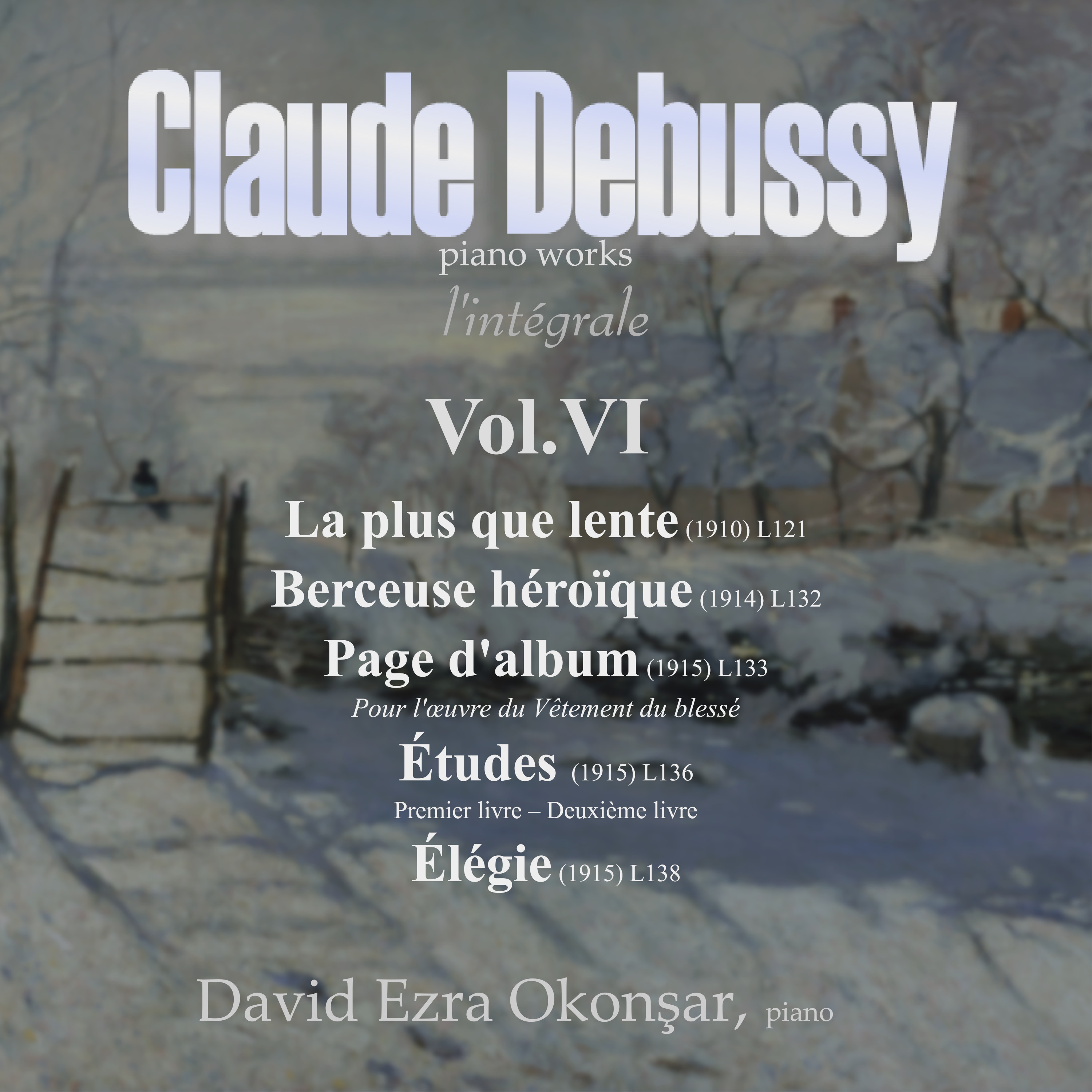
The Culmination of a Monumental Journey: Debussy's Complete Piano Works, Volume VI With the publication of this sixth and final volume of Claude Debussy's complete piano works, we arrive at the apex of an extraordinary journey through the oeuvre of one of the most influential composers in music history. This volume, dedicated to the Études for piano, represents not only a cornerstone of Debussy's pianistic output but also an enduring testament to his innovative spirit and artistic depth. Over the course of the previous five volumes, I have sought to present Debussy's piano works in their entirety, with meticulous attention to detail, stylistic fidelity, and interpretative insight. These volumes have included such monumental collections as the "Préludes", "Images", "Estampes", and "Suite bergamasque", alongside a host of other seminal works that define Debussy's contribution to the repertoire. Each volume has aimed to illuminate Debussy's evolution as a composer and his unparalleled ability to expand the expressive possibilities of the piano. The Études: A Pinnacle of Debussy's Art Composed in 1915, during a time of personal and national crisis, the Études mark one of Debussy's final contributions to the solo piano repertoire. Structured in two books of six pieces each, the Études are, on the surface, technical studies aimed at exploring specific pianistic challenges. Yet, they transcend mere didacticism, revealing a profound exploration of the relationship between technique, sound, and musical imagination. Debussy dedicated the Études to the memory of Frédéric Chopin, a gesture that underscores their lineage within the tradition of piano studies while also hinting at their revolutionary departure from it. Where Chopin’s études often blend technical display with overt lyricism, Debussy’s works employ an unprecedented abstraction, where technical principles become the foundation for strikingly original soundscapes. In his own words, Debussy described the Études as "a warning to pianists not to take up the musical profession unless they have remarkable hands." Book I: From Technique to Artistry The first book of Études focuses on fundamental technical challenges, such as scales ("Pour les cinq doigts"), arpeggios ("Pour les arpèges composés"), and octaves ("Pour les octaves"). Yet, each piece transforms its technical premise into an artistic exploration. For instance, "Pour les cinq doigts" evolves from a straightforward exercise into a playful, almost ironic commentary on the very nature of pianistic pedagogy. Similarly, "Pour les arpèges composés" unfolds as a kaleidoscope of harmonic color, where arpeggios are not merely patterns but vehicles for Debussy’s characteristically rich and unexpected harmonic language. Book II: Towards Abstraction The second book ventures further into abstraction, addressing pianistic challenges that are less immediately tangible yet deeply evocative. "Pour les notes répétées" explores the shimmering possibilities of repeated notes, while "Pour les sonorités opposées" juxtaposes contrasting sonorities in ways that seem to anticipate the timbral experiments of 20th-century composers like Messiaen and Boulez. The final Étude, "Pour les accords", stands as a monumental exploration of harmony and sonority, culminating the set with a sense of both closure and openness, inviting pianists and listeners alike to reflect on the infinite possibilities of sound. The Études in Context Within the broader context of Debussy’s output, the Études represent a distillation of his mature style. They are works of intellectual rigor and imaginative breadth, embodying Debussy's lifelong quest to liberate music from convention. The harmonic innovations, rhythmic fluidity, and textural sophistication that characterize these pieces reflect the same creative principles that shaped earlier masterpieces like the "Préludes". However, the Études also signal a departure, pointing towards a musical modernity that continues to resonate in the works of later composers. Reflections on the Complete Edition This final volume completes a series that has been both a professional and personal labor of love. The journey through Debussy’s piano works has been one of constant discovery, revealing new layers of meaning and beauty with each piece. From the dreamlike poetry of the "Préludes" to the evocative imagery of the "Images" and the crystalline clarity of the "Children’s Corner", these works collectively represent the essence of Debussy’s genius. In presenting this edition, my aim has been not only to provide an authoritative interpretation of Debussy's music but also to inspire pianists and listeners to engage deeply with his art. The Études, in particular, challenge us to reconsider the very nature of pianistic expression, inviting us to approach the piano not merely as an instrument but as a medium for creating new worlds of sound. As we close this chapter, I am filled with gratitude for the opportunity to bring these extraordinary works to life. It is my hope that this edition will serve as a resource and inspiration for pianists and music lovers for generations to come, ensuring that Debussy’s voice continues to resonate with the same vitality and freshness that it has for over a century. |
||||||||||||||||||||||||||
| |
||||||||||||||||||||||||||
|
||||||||||||||||||||||||||