Downloads only. Physical CD not available.
|
The Garden of Rain
Trees (Symphony 13)
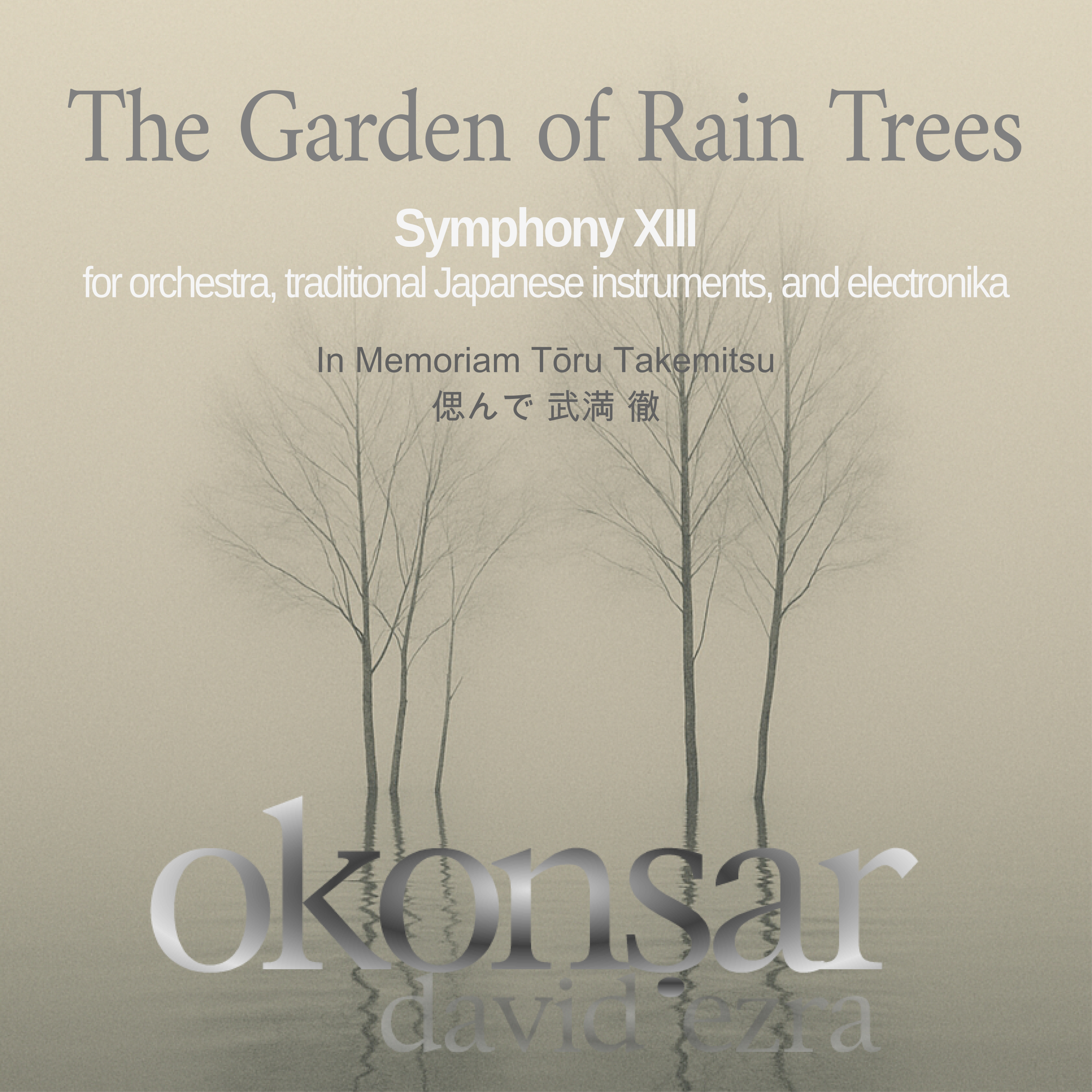
for orchestra, traditional Japanese instruments, and electronika In Memoriam Tōru Takemitsu 偲んで 武満 徹 The Garden of Rain Trees — Symphony XIII (In Memoriam Tōru Takemitsu) David Ezra Okonsar’s Symphony XIII, The Garden of Rain Trees, stands as both a tribute and an exploration: a large-scale orchestral work dedicated to the memory of Tōru Takemitsu, yet deeply anchored in Okonsar’s own compositional universe. The title evokes one of Takemitsu’s most resonant metaphors, the “rain tree,” which he described as a living organism that absorbs, transforms, and redistributes light and water. For Takemitsu, music itself was such a tree: branching, fluid, and ceaselessly renewing. Okonsar’s symphony extends this image into his own idiom, creating a sonic landscape where sound, silence, and memory intertwine. Takemitsu often characterized music as “a garden that breathes,” where each sound is alive and never complete in itself. He distrusted rigid formal schemes and rejected conventional symphonic hierarchies in favor of organic growth, timbral resonance, and the integration of silence—ma—as an essential component. In this respect, there is a profound kinship with Okonsar’s approach. Like Takemitsu, Okonsar conceives the orchestra not as a stage for domination, with soloists in front and accompaniment behind, but as an ecosystem. A particularly rich point of contact is the Japanese aesthetic notion of ma, which Takemitsu described as “an unfilled space full of possibilities.” Okonsar has long engaged with this idea in his own work, most explicitly in his Chamber Symphony “MA” (Symphony No. 4). In that earlier composition, Okonsar explored ma not as emptiness but as an active silence—intervals that shape and redefine the flow of sound, moments where anticipation and resonance hold equal weight with pitched material. In Symphony XIII, this exploration deepens. Silence punctuates and frames the orchestral discourse, becoming a force as palpable as the notes themselves. In this sense, The Garden of Rain Trees can be heard as a continuation of a dialogue begun in the Chamber Symphony “MA”, now refracted through the lens of Takemitsu’s spirit and memory. Yet Okonsar’s voice remains unmistakably his own. Where Takemitsu often favored delicate transparency, an almost painterly balance of sound-colors, Okonsar embraces greater density, contrapuntal intricacy, and at times extreme pianistic virtuosity. If Takemitsu’s music evokes the quiet breathing of a Japanese garden—stones, moss, the trickle of water—Okonsar’s garden is wilder, layered, and unpredictable: branches twist, shadows overlap, and light refracts into unexpected intensities. The affinity lies not in surface imitation but in a shared conviction that music should grow like nature itself—unforced, irregular, and alive. Takemitsu’s inspirations often came from literature, poetry, and painting, and he transformed traditional Japanese instruments such as the biwa and shakuhachi into contemporary contexts. Okonsar extends this idea by integrating shamisen, koto, and shakuhachi into the orchestral texture of Symphony XIII. They are not introduced as exotic timbral ornaments but as full participants in the dialogue, their voices interwoven with Western instruments and modern electronic sounds—what Okonsar names “electronika.” The result is a music that seeks a genuine cultural synthesis, not a juxtaposition of opposites but a coalescence into a single resonant whole. Equally important is the temporal design of the work. Like Takemitsu, Okonsar avoids the conventional fast–slow–fast pattern of symphonic construction. Each movement undergoes fluid transformation, sometimes meditative, sometimes scherzo-like, sometimes eruptive, yet never locked into predictable sequences. The music unfolds as if guided by memory and dream rather than architectural blueprint. This refusal of rigid formality mirrors Takemitsu’s conviction that “the structure of music should be discovered like the flow of nature, not imposed upon it.” Okonsar’s Symphony XIII is therefore not merely an homage but a dialogue across time and culture. It acknowledges Takemitsu’s legacy while advancing Okonsar’s own compositional path. The dedication In Memoriam Tōru Takemitsu (偲んで 武満徹) is more than ceremonial; it is an act of kinship. Both composers share a belief that music is not an artifact but a living experience, something to be entered rather than observed. Takemitsu once wrote: “My music is like a garden of dreams; each sound is a leaf, each silence a path.” In Okonsar’s The Garden of Rain Trees, listeners are invited to wander in a similar way—guided by shifting timbres, unpredictable currents, and silences that open into new dimensions of perception. Ultimately, Symphony XIII continues the conversation between East and West, sound and silence, memory and presence. It reflects Okonsar’s lifelong engagement with the deepest questions of musical form and experience while honoring Takemitsu’s vision of sound as both fragile and eternal. It is a work that invites us not only to listen but to dwell—to find ourselves, for a time, beneath the branches of the rain tree.
-------------------------------------------------- FR La Symphonie XIII, Le Jardin des Arbres de Pluie de David Ezra Okonsar se présente à la fois comme un hommage et une méditation : une œuvre conçue dans la mémoire de Tōru Takemitsu, mais qui demeure profondément ancrée dans l’univers personnel du compositeur. Le titre évoque l’une des images les plus marquantes de Takemitsu, celle de « l’arbre de pluie », métaphore vivante de la transformation et du renouvellement. Pour Takemitsu, la musique elle-même était semblable à cet arbre : un organisme qui respire, qui absorbe, qui se ramifie et qui redistribue sans cesse la lumière et l’eau. Takemitsu aimait définir la musique comme « un jardin qui respire », un espace sonore fluide, fragile et en perpétuelle métamorphose. Il se méfiait des structures trop rigides et des hiérarchies symphoniques traditionnelles, préférant un déploiement organique, fondé sur les couleurs sonores et sur l’intégration du silence. C’est là que se manifeste une profonde affinité avec l’esthétique d’Okonsar. Un point de contact particulièrement riche réside dans la notion japonaise de ma, ce silence actif que Takemitsu considérait non pas comme une absence, mais comme un espace de plénitude, porteur de potentialité. Okonsar s’est lui-même confronté à cette idée dans sa Chamber Symphony “MA” (Symphonie n°4). Dans cette œuvre, le silence n’est pas un vide, mais une force agissante qui sculpte et reconfigure la temporalité musicale. La Symphonie XIII approfondit et prolonge cette réflexion : ici, le silence alterne avec la densité orchestrale, créant des espaces chargés de tension, où mémoire et attente deviennent aussi expressives que le son lui-même. Toutefois, la voix d’Okonsar demeure singulière. Là où Takemitsu privilégiait souvent la transparence et l’équilibre subtil des timbres, Okonsar assume une densité contrapuntique, une complexité stratifiée, et parfois une virtuosité pianistique extrême. Si la musique de Takemitsu évoque la respiration d’un jardin japonais — pierres, mousse, eau qui s’écoule — celle d’Okonsar ressemble davantage à un jardin sauvage, foisonnant, où les branches s’entrecroisent, où la lumière se diffracte en intensités imprévues. L’affinité entre les deux n’est pas d’ordre imitatif, mais repose sur une conviction partagée : la musique doit croître comme la nature, de manière irrégulière et vivante. Takemitsu trouvait son inspiration dans la poésie, la peinture, la littérature, et il fit entrer des instruments traditionnels tels que le biwa ou le shakuhachi dans un langage moderne. Okonsar prolonge cette démarche en intégrant le shamisen, le koto et le shakuhachi dans le tissu orchestral de la Symphonie XIII, en dialogue avec l’orchestre occidental et les sons électroniques — qu’il nomme « electronika ». Ces instruments ne sont pas de simples couleurs exotiques, mais des voix à part entière, participant à une véritable synthèse culturelle. La conception temporelle de l’œuvre se démarque elle aussi des archétypes. Plutôt qu’une alternance traditionnelle rapide–lent–rapide, les mouvements se transforment de façon fluide, parfois méditatifs, parfois scherzando, parfois éruptifs, sans jamais se figer dans des schémas prévisibles. L’impression qui en résulte est celle d’une mémoire en mouvement, d’un flux onirique où les frontières temporelles se dissolvent. Takemitsu écrivait que « la structure de la musique doit être découverte comme le cours de la nature, et non imposée ». La démarche d’Okonsar s’inscrit dans cette continuité. La Symphonie XIII n’est donc pas seulement un hommage, mais un dialogue. La dédicace « À la mémoire de Tōru Takemitsu » (偲んで 武満徹) dépasse la dimension cérémonielle : elle exprime une parenté spirituelle. Les deux compositeurs partagent la conviction que la musique n’est pas un objet figé, mais une expérience vécue, un espace à habiter. Takemitsu déclarait : « Ma musique est comme un jardin de rêves ; chaque son est une feuille, chaque silence est un chemin. » Dans le Jardin des Arbres de Pluie, Okonsar invite l’auditeur à cheminer de la même manière — guidé par les timbres, les silences, les flux imprévus — dans un espace où fragilité et puissance coexistent, où le son se déploie avant de s’évanouir dans le silence. En définitive, cette Symphonie XIII prolonge la conversation entre Orient et Occident, entre son et silence, entre mémoire et présence. Elle reflète l’engagement d’Okonsar envers les questions essentielles de la forme et de l’expérience musicale, tout en honorant la vision de Takemitsu, pour qui le son, fragile et éphémère, ouvre sur l’éternité. C’est une œuvre qui n’invite pas seulement à l’écoute, mais à l’habitation : à se placer, le temps d’un instant, sous les branches de l’arbre de pluie. -------------------------------------------------- TR David Ezra Okonsar’ın Senfoni XIII, The Garden of Rain Trees adlı yapıtı, hem bir anma hem de bir içsel yolculuk olarak düşünüldü: Tōru Takemitsu’ya adanmış büyük ölçekli bir senfoni ama aynı zamanda bestecinin kişisel dünyasına derinlemesine bağlı. Başlık, Takemitsu’nun en sevilen imgelerinden birini çağrıştırıyor: “yağmur ağacı.” Bu ağaç, onun için dönüşümün, yenilenmenin, ışığın ve suyun doğada sürekli dolaşımının bir simgesiydi. Takemitsu’ya göre müzik de tıpkı bu ağaç gibi yaşayan bir organizmaydı; dallanıp budaklanan, nefes alan, ışığı ve sessizliği farklı biçimlerde yansıtan. Takemitsu müziği sık sık “nefes alan bir bahçe” olarak tanımlardı. Katı yapıları, mekanik simetriyi reddeder, bunun yerine renklerin akışına, sesin zamandaki çözülüşüne ve sessizliğin (Japon estetiğinde ma) yaratıcı rolüne önem verirdi. Bu bakımdan Okonsar ile güçlü bir ortaklık vardır. Özellikle dikkat çekici olan nokta, Japon estetik kavramı ma’dır: boşluk değil, olasılıklarla dolu aktif bir aralık. Takemitsu için ma, sesin çerçevesi ve anlamını tamamlayan boyutuydu. Okonsar, bu kavramla yıllar önce Chamber Symphony “MA” (Senfoni No.4) adlı yapıtında doğrudan hesaplaştı. Orada sessizlik, boşluk değil; zamanın akışını şekillendiren, beklentiyi yoğunlaştıran, belleği harekete geçiren etkin bir öğeydi. The Garden of Rain Trees bu düşünceyi daha ileri taşır: sessizlik, yoğun orkestral bloklarla dönüşümlü olarak işitilir ve müziğin en az ses kadar güçlü bir öğesi haline gelir. Bununla birlikte Okonsar’ın sesi her zaman özgündür. Takemitsu çoğu zaman saydamlık ve hafifliği tercih ederken, Okonsar yoğun kontrapuntal dokulara, karmaşık katmanlara ve kimi zaman aşırı derecede virtüoz piyano pasajlarına yönelir. Takemitsu’nun müziği bir Japon bahçesinin dingin nefesini — taşları, yosunları, akan suyu — çağrıştırırken, Okonsar’ın bahçesi daha vahşi, daha yoğun, ışığın beklenmedik kırılmalarla farklı yansımalar yarattığı, dalların birbirine dolandığı bir mekândır. Ortaklık yüzeysel benzerlikte değil, doğanın kendiliğinden büyümesine duyulan ortak inançtadır. Takemitsu, şiirden, resimden, edebiyattan ilham alır; biwa ve shakuhachi gibi geleneksel Japon çalgılarını çağdaş bağlama taşırdı. Okonsar da bu yaklaşımı sürdürerek shamisen, koto ve shakuhachi’yi Batı orkestrası ve elektronik seslerle (bestecinin “electronika” adını verdiği) kaynaştırır. Bu çalgılar yalnızca egzotik renkler olarak değil, eşit düzeyde diyalog kuran sesler olarak yer alır. Burada amaç, Doğu ile Batı’nın yüzeysel karşılaşması değil, gerçek bir kültürel sentezdir. Eserin zaman anlayışı da geleneksel kalıpları reddeder. Hızlı–yavaş–hızlı gibi şemalara bağlı kalmak yerine, hareketler organik biçimde değişir: kimi zaman meditasyona yakın, kimi zaman scherzo benzeri, kimi zaman patlayıcı. Ortaya çıkan etki, belleğin ve düşlerin şekillendirdiği bir akış gibidir. Takemitsu’nun, “müziğin yapısı doğanın akışı gibi keşfedilmeli, dışarıdan dayatılmamalı” sözü, burada doğrudan yankılanır. The Garden of Rain Trees, bu nedenle yalnızca bir saygı duruşu değil, zamanlar ve kültürler arasında kurulmuş bir diyaloğun devamıdır. “Tōru Takemitsu’nun anısına” (偲んで 武満徹) yapılan ithaf, törensel bir formül olmanın ötesinde bir ruhsal akrabalığı ifade eder. Her iki besteci de müziği sabit bir nesne değil, yaşanacak bir deneyim, girilecek bir mekân olarak görür. Takemitsu, “Müziğim bir düşler bahçesi gibidir; her ses bir yaprak, her sessizlik bir yol” demişti. Okonsar’ın The Garden of Rain Trees’inde de dinleyici aynı şekilde davet edilir: timbrlerin ve sessizliklerin yönlendirdiği bir bahçede dolaşmaya, kırılganlık ve yoğunluğun birlikte var olduğu bir alanda soluk almaya. Sonuçta bu Senfoni XIII, Doğu ile Batı, ses ile sessizlik, bellek ile şimdi arasındaki konuşmayı sürdürür. Okonsar’ın müzikal biçim ve deneyim üzerine uzun süredir süregelen araştırmalarını yansıtırken, Takemitsu’nun kırılgan ama sonsuz olan vizyonuna da saygı duruşunda bulunur. Bu yapıt, yalnızca dinlenmek için değil, yaşamak için davet eder: bir anlığına, yağmur ağacının dalları altında durmak için. |
|||||||||||||||||||||||||
| |
|||||||||||||||||||||||||
|
|||||||||||||||||||||||||