Downloads only. Physical CD not available.
|
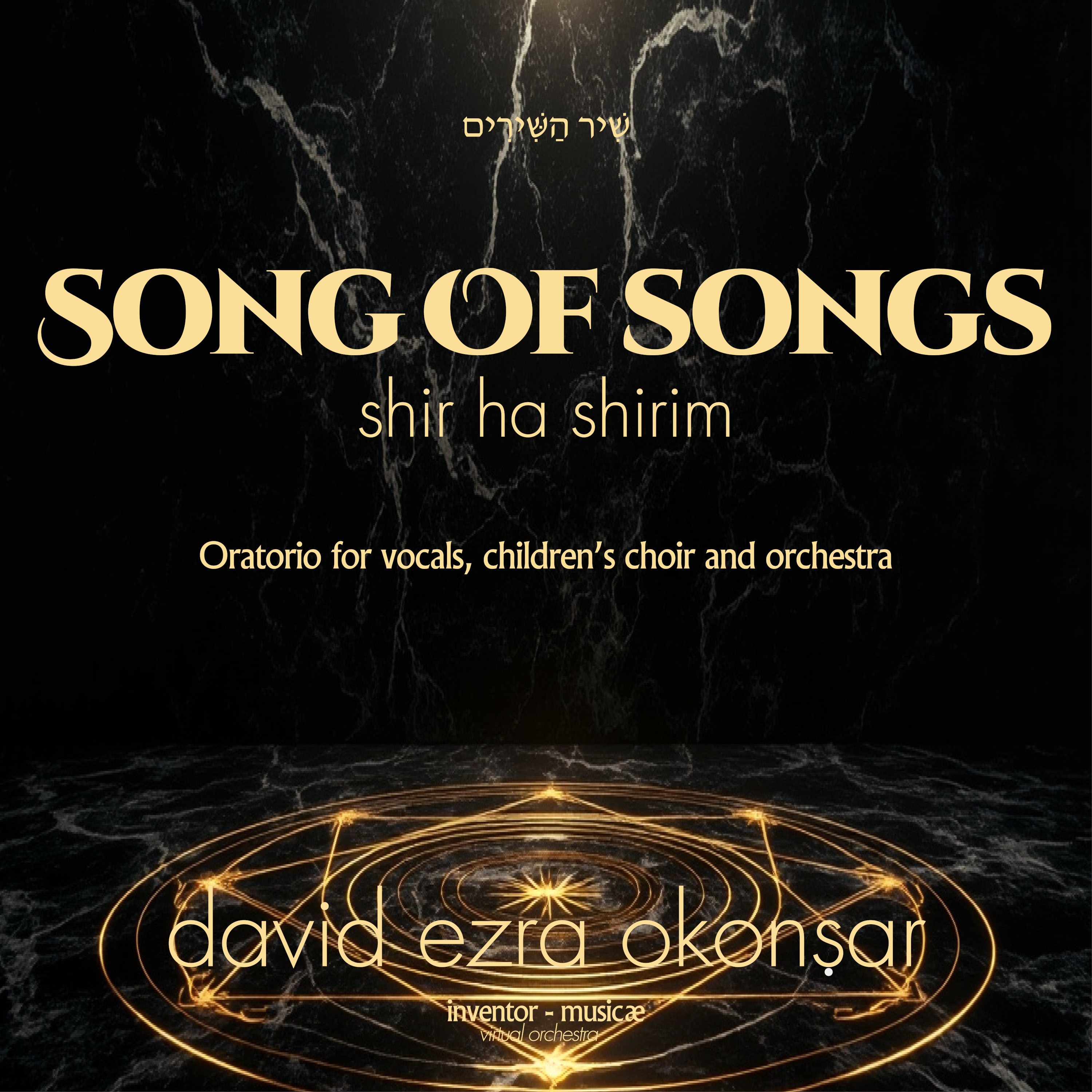
SONG OF SONGS (SHIR HA SHIRIM) — STAGE ORATORIO Song of Songs (Shir ha Shirim) is a stage oratorio inspired by one of the most enigmatic and sensuous poetic texts of the biblical tradition. Rather than treating the Song as a linear narrative, David Ezra Okonsar approaches it as a vast interior landscape in which desire, absence, beauty, memory and reunion continually transform one another. The ancient poem becomes the point of departure for a contemporary musical meditation on love in its physical, emotional and transcendent dimensions. At the centre of the work are two voices seeking, praising, losing and rediscovering one another. Around them, the chorus does not merely comment upon the action: it becomes city, night, garden, memory, collective consciousness and, at times, the resonating space in which the lovers hear themselves. The distinction between individual and collective voice is therefore fluid. Words may emerge from silence, pass from one singer to another, dissolve into choral textures or return transformed, as though the poem itself were remembering its own images. The oratorio unfolds in eight large chapters: The Opening Breath, The Awakening of Desire, The Night of Seeking, The Praise and the Garden, The Descent into Absence, The Garden of Reunion, The Dance of Belonging, and The Seal of Eternal Love. Together they form an arch from awakening to desire, from desire to separation, and from separation toward a reunion that ultimately transcends the individual lovers. The garden is one of the central symbols of the work. It is at once a physical place, the beloved body, an image of fertility and abundance, and an interior territory accessible only through love. Fragrance, water, fruit, flowers, wind, darkness and light recur throughout the score as a network of poetic resonances. Their meanings are never fixed: an image first associated with expectation may return later as memory, absence or fulfilment. In this way, the musical structure reflects the extraordinary associative logic of the original poetry. The dramatic trajectory deliberately avoids conventional theatrical realism. There are no characters in the operatic sense and no attempt to reconstruct an ancient world. The stage instead functions as a poetic and psychological space. Presence and absence, proximity and distance, darkness and illumination become dramatic materials in themselves. The lovers may inhabit the same physical space while remaining unreachable to one another, or be separated while their voices become musically inseparable. Musically, Song of Songs inhabits the language of contemporary classical music while preserving the immediacy and corporeal force of sung poetry. Vocal lines may move between intimate utterance, lyrical expansion, fragmented speech and collective proclamation. Instrumental textures function not simply as accompaniment but as extensions of breath, landscape and psychological space. Silence is equally structural: pauses, suspended sonorities and moments of near-immobility allow the words and their resonances to remain present after they have been sung. The final chapter takes its point of departure from the celebrated declaration, “Set me as a seal upon your heart.” Here the private language of the lovers opens toward something universal. Love is no longer merely longing for another person; it becomes a force measured against death, separation and time itself. The biblical image of waters unable to extinguish love gives the work its ultimate horizon. The oratorio therefore ends not with conventional resolution, but with permanence. What began as a breath becomes desire; desire becomes seeking; seeking passes through absence and reunion; and reunion finally becomes a seal. The ancient Song remains unanswered and inexhaustible—a poem in which human love, precisely through the intensity of its physical presence, continually approaches the infinite. FR LE CANTIQUE DES CANTIQUES (SHIR HA SHIRIM) — ORATORIO SCÉNIQUE Le Cantique des Cantiques (Shir ha Shirim) est un oratorio scénique inspiré par l’un des textes poétiques les plus énigmatiques et sensuels de la tradition biblique. Plutôt que d’aborder le Cantique comme un récit linéaire, David Ezra Okonsar le conçoit comme un vaste paysage intérieur où le désir, l’absence, la beauté, la mémoire et les retrouvailles ne cessent de se transformer mutuellement. Le poème ancien devient ainsi le point de départ d’une méditation musicale contemporaine sur l’amour dans ses dimensions charnelle, émotionnelle et transcendante. Au centre de l’œuvre se trouvent deux voix qui se cherchent, se célèbrent, se perdent et se retrouvent. Autour d’elles, le chœur ne se limite pas à commenter l’action : il devient tour à tour ville, nuit, jardin, mémoire, conscience collective et espace de résonance dans lequel les amants s’entendent eux-mêmes. La frontière entre voix individuelle et voix collective demeure ainsi constamment mouvante. Les mots peuvent naître du silence, passer d’un chanteur à l’autre, se dissoudre dans la matière chorale puis réapparaître transformés, comme si le poème lui-même se souvenait de ses propres images. L’oratorio se déploie en huit grands chapitres : The Opening Breath, The Awakening of Desire, The Night of Seeking, The Praise and the Garden, The Descent into Absence, The Garden of Reunion, The Dance of Belonging et The Seal of Eternal Love. Ils dessinent ensemble une vaste arche allant de l’éveil au désir, du désir à la séparation, puis de la séparation vers des retrouvailles qui finissent par dépasser les amants eux-mêmes. Le jardin constitue l’un des symboles fondamentaux de l’œuvre. Il est simultanément lieu réel, corps de l’être aimé, image de fertilité et d’abondance, et territoire intérieur auquel seul l’amour donne accès. Parfums, eaux, fruits, fleurs, vent, obscurité et lumière parcourent la partition comme un réseau de résonances poétiques. Leur signification n’est jamais immuable : une image associée d’abord à l’attente peut revenir sous la forme du souvenir, de l’absence ou de l’accomplissement. La structure musicale rejoint ainsi la remarquable logique associative de la poésie originelle. La dramaturgie évite délibérément le réalisme théâtral conventionnel. Il n’existe pas de personnages au sens opératique du terme, ni de tentative de reconstitution d’un monde antique. La scène fonctionne plutôt comme un espace poétique et psychologique. Présence et absence, proximité et distance, obscurité et lumière deviennent elles-mêmes des matériaux dramatiques. Les amants peuvent partager un même espace tout en demeurant inaccessibles l’un à l’autre, ou être physiquement séparés tandis que leurs voix deviennent musicalement indissociables. Musicalement, Le Cantique des Cantiques s’inscrit dans le langage de la musique classique contemporaine tout en préservant l’immédiateté et la force corporelle de la poésie chantée. Les lignes vocales évoluent entre confidence intime, expansion lyrique, parole fragmentée et proclamation collective. Les textures instrumentales ne constituent pas un simple accompagnement : elles prolongent le souffle, le paysage et l’espace psychologique. Le silence lui-même possède une fonction structurelle ; pauses, sonorités suspendues et moments de quasi-immobilité permettent aux mots et à leurs résonances de demeurer présents après leur disparition sonore. Le dernier chapitre prend pour point de départ la célèbre déclaration : « Pose-moi comme un sceau sur ton cœur. » Le langage privé des amants s’ouvre alors sur une dimension universelle. L’amour n’est plus seulement désir de l’autre : il devient une force confrontée à la mort, à la séparation et au temps. L’image biblique des grandes eaux incapables d’éteindre l’amour donne à l’œuvre son horizon ultime. L’oratorio ne s’achève donc pas sur une résolution conventionnelle, mais sur une idée de permanence. Ce qui naissait comme un souffle devient désir ; le désir devient quête ; la quête traverse l’absence et les retrouvailles ; les retrouvailles deviennent enfin un sceau. L’antique Cantique demeure sans réponse définitive et inépuisable : un poème où l’amour humain, précisément par l’intensité de sa présence charnelle, ne cesse de s’approcher de l’infini. TR NEŞİDELER NEŞİDESİ (SHIR HA SHIRIM) — SAHNELENMİŞ ORATORYO Neşideler Neşidesi (Shir ha Shirim), Kutsal Kitap geleneğinin en gizemli ve duyusal şiirsel metinlerinden birinden esinlenen sahnelenmiş bir oratoryodur. David Ezra Okonsar, metni doğrusal bir anlatı olarak ele almak yerine; arzunun, yokluğun, güzelliğin, belleğin ve yeniden kavuşmanın sürekli olarak birbirine dönüştüğü geniş bir içsel manzara olarak yorumlar. Kadim şiir böylece aşkın bedensel, duygusal ve aşkın boyutları üzerine çağdaş bir müzikal düşüncenin çıkış noktasına dönüşür. Eserin merkezinde birbirini arayan, öven, kaybeden ve yeniden bulan iki ses yer alır. Onların çevresindeki koro ise yalnızca olaylara yorum getiren bir topluluk değildir; kimi zaman şehir, kimi zaman gece, bahçe, bellek, ortak bilinç ve âşıkların kendi seslerini duydukları bir rezonans alanına dönüşür. Böylece bireysel ve kolektif ses arasındaki sınır sürekli değişir. Sözcükler sessizlikten doğabilir, bir şarkıcıdan diğerine geçebilir, koro dokusunun içinde eriyebilir ve daha sonra dönüşmüş olarak yeniden ortaya çıkabilir; sanki şiirin kendisi kendi imgelerini hatırlamaktadır. Oratoryo sekiz büyük bölüm halinde gelişir: The Opening Breath, The Awakening of Desire, The Night of Seeking, The Praise and the Garden, The Descent into Absence, The Garden of Reunion, The Dance of Belonging ve The Seal of Eternal Love. Bu bölümler birlikte uyanıştan arzuya, arzudan ayrılığa ve ayrılıktan, sonunda iki âşığın bireysel varlığını aşan bir yeniden kavuşmaya uzanan büyük bir dramatik yay oluşturur. Bahçe, eserin temel simgelerinden biridir. Aynı anda gerçek bir mekân, sevgilinin bedeni, bereket ve bolluğun imgesi ve yalnızca aşk aracılığıyla ulaşılabilen içsel bir ülke olarak belirir. Kokular, sular, meyveler, çiçekler, rüzgâr, karanlık ve ışık, partisyon boyunca şiirsel bir rezonans ağı oluşturur. Bu imgelerin anlamları hiçbir zaman sabit değildir: başlangıçta bekleyişle bağlantılı olan bir imge daha sonra anı, yokluk ya da tamamlanma olarak geri dönebilir. Böylece müzikal yapı, özgün şiirin olağanüstü çağrışımsal mantığını yansıtır. Eserin dramaturjisi bilinçli olarak geleneksel teatral gerçekçilikten uzak durur. Operatik anlamda tanımlanmış karakterler yoktur ve kadim bir dünyanın tarihsel olarak yeniden kurulması amaçlanmaz. Sahne bunun yerine şiirsel ve psikolojik bir alan olarak işlev görür. Varlık ve yokluk, yakınlık ve uzaklık, karanlık ve aydınlık başlı başına dramatik malzemelere dönüşür. Âşıklar aynı fiziksel mekânda bulundukları halde birbirlerine ulaşamayabilir ya da birbirlerinden uzaktayken sesleri müzikal olarak ayrılmaz hâle gelebilir. Müzikal açıdan Neşideler Neşidesi, çağdaş klasik müzik dilinde konumlanırken söylenen şiirin doğrudanlığını ve bedensel gücünü korur. Vokal çizgiler mahrem söyleyiş, lirik genişleme, parçalanmış söz ve kolektif haykırış arasında hareket edebilir. Enstrümantal dokular yalnızca eşlik görevi görmez; nefesin, manzaranın ve psikolojik mekânın uzantılarına dönüşür. Sessizlik de yapısal bir unsurdur: duraklamalar, askıda kalan sonoriteler ve neredeyse hareketsiz anlar, sözcüklerin söylendikten sonra da yankılarıyla varlıklarını sürdürmelerine olanak verir. Son bölüm, “Beni yüreğinin üzerine bir mühür gibi koy” şeklindeki ünlü sözden hareket eder. Burada âşıkların özel dili evrensel bir boyuta açılır. Aşk artık yalnızca başka bir insana duyulan özlem değildir; ölüm, ayrılık ve zamanın kendisiyle ölçülen bir güce dönüşür. Büyük suların dahi aşkı söndüremeyeceğini söyleyen kutsal metin imgesi, eserin nihai ufkunu belirler. Oratoryo bu nedenle geleneksel bir çözüme değil, kalıcılık düşüncesine ulaşarak sona erer. Bir nefes olarak başlayan şey arzuya; arzu arayışa; arayış yokluk ve kavuşmaya; kavuşma ise sonunda bir mühre dönüşür. Kadim Neşideler Neşidesi kesin bir yanıt sunmadan, tükenmezliğini korur: insan aşkının, tam da bedensel varlığının yoğunluğu aracılığıyla, durmaksızın sonsuza yaklaştığı bir şiir. #SongOfSongs #ShirHaShirim #CanticleOfCanticles #StageOratorio #Oratorio #ContemporaryClassical #ContemporaryMusic #ClassicalMusic #VocalMusic #ChoralMusic #SacredPoetry #BiblicalPoetry #MusicTheatre #ModernClassical #DavidEzraOkonsar |
|||||||||||||||||||||||||
| Detailed Movements I. The Opening Breath (Awakening) From primordial stillness, the first breath of love emerges. The voices awaken gradually, as if speech itself were being born from silence, opening the work’s world of longing, fragrance, memory, and desire. II. The Awakening of Desire (The First Call) Love becomes conscious of itself. The lovers begin to call toward one another across an unseen distance, and the first images of beauty, perfume, touch, and yearning gather into an increasingly ardent musical dialogue. III. The Night of Seeking (Where Has My Beloved Gone?) The beloved is absent. Through darkness, streets, and silence, the searching voice moves restlessly between hope and fear. Desire becomes pilgrimage: what was once attraction is transformed into the necessity of seeking. IV. The Praise and the Garden (Behold, You Are Beautiful) The lovers behold and name one another through cascades of poetic images. Body, landscape, fragrance, fruit, water, and garden become inseparable, and praise expands from intimate declaration into a luminous celebration of creation. V. The Descent into Absence (I Sought Him, but Found Him Not) Union is interrupted and the beloved withdraws. The search returns in a darker form: doors close, the night becomes hostile, and longing acquires the weight of loss. Love must endure absence without knowing whether reunion will come. VI. The Garden of Reunion (I Am My Beloved’s) The distance collapses. Recognition replaces searching, and the garden returns not merely as a place but as the inner space of restored intimacy. Earlier images are transformed as the lovers rediscover one another in a deeper and quieter union. VII. The Dance of Belonging (Come, My Beloved) Love moves outward again—into fields, vineyards, movement, and shared life. The lovers no longer seek possession but freely belong to one another; intimacy becomes a joyful, expansive affirmation of mutual desire. VIII. The Seal of Eternal Love (Set Me as a Seal upon Your Heart) The personal love of the two lovers reaches beyond them. Love is proclaimed stronger than death, unquenchable by the waters and beyond all price. The work closes not with an ending but with a seal: love transformed into permanence. |
|||||||||||||||||||||||||
|
|||||||||||||||||||||||||